Our Roots
OC International Inc. (formerly known as Overseas Crusades) was founded in 1952 as an American non-profit mission. OC has been on a long journey toward internationalization. Core to our DNA is coming alongside indigenous leaders/churches/networks – at their invitation – to partner toward the discipling of their nation and, ultimately, the nations.
For the first twenty years, immediate attention was given to the mission to the majority world. Then, in the 70s, OC began to concentrate on promoting missions from the majority world. The successor to our founder Dick Hillis was an Argentinian, Luis Palau, who served as our second president. An expression of mission within a country, the Discipling the Whole Nation (DAWN) strategy emerged from our work in the Philippines with a focus on reaching every ethnic group, strata of society, and geographic area in a country. This involved cross-cultural mission sending within a nation. Since 1975, the Philippines experiment stimulated the planting of over eighty thousand churches across the country and inspired national saturation church planting initiatives globally.
In the ’80s, OC’s fourth president, Dr. Larry Keyes, and Dr. Larry Pate led ground-breaking global research on emerging missions with findings published in The Last Age of Missions and To Every People From Every People. For years OC published the “Bridging People’s” newsletter to highlight mission innovation from the majority world. As OC’s work spread worldwide, teams were encouraged to adopt indigenous names, such as Philippine Challenge, Outreach Canada, and SEPAL (translated Serving Pastors and Leaders) in Ibero-America.
OC workers Ted Limpic, Tim Halls, and Larry Kraft walked closely alongside Latino leaders in the launch of COMIBAM, and successive OC workers have contributed to the mobilization, equipping, and sustaining of Latino missionaries. OC also helped launch the United College of Mission and Theology in Nagaland, India, to support the church in Nagaland toward its goal of sending 10,000 missionaries. Similarly, OC assisted the Nigerian Evangelical Missions Association in its early years and has walked closely with the Movement for African National Initiatives since its inception.
OC has a history of initiatives to encourage, assist, advise, and equip mission-sending within and beyond the countries we’ve served. During our first thirty years, an effort was made to stimulate the emergence of indigenous, non-OC mission structures and networks.
Our Transition
Over time, with increasing numbers of Asians, Africans, and Latin Americans asking to join OC, we began experimenting with various internationalization models with multi-national teams. Through trial and error, this process eventually culminated in the design and launch of the OCGA.
In 2005 OC was reaching a tipping point where there were as many internationals serving on our teams as Americans. A meeting was convened in Manila in the spring of 2008 to discuss the growing international component of OC. Internationalization was creating innovative opportunities for mobilization and recruiting along with new challenges of funding structures and member care. A new, flatter model would liberate national teams to do their own recruiting, funding, and member care for their people. By the end of the Manila meeting, we had designed our alliance model, and it was ratified and implemented in 2009. The OC Global Alliance was born; by 2010, fifty-eight percent of our personnel were non-US sent.
The Birth of the new Alliance was risky. The US-based mission released eight of their largest national fields to become fully independent mobilization centers (MC). The US MC supported the new MCs as they developed their boards and provided guidelines for handling finance, personnel, and partnerships. The new alliance was held together by our Unifying Essentials: our statement of faith accompanied by our shared vision, mission, strategy, and values. We recognized that solid relationships and mutual trust would be the glue to hold the alliance together. Many of our peers watched with eager anticipation as we charted new waters they would also have to navigate. We launched the new model with much prayer and dependence upon the Holy Spirit.
Our Alliance Structure
The structure of the OC Global Alliance is based on a round table where all partnering MCs gather as equals. Each MC appoints two individuals to represent them at the Alliance table, where we meet biennially.
Our leadership model is flat. We do not have a president or chairman but a guidance team, which helps to facilitate the decisions and directions of the alliance. Past moderators of the guidance team came from Singapore, the United Kingdom, the United States, and Canada. We are mutually accountable to each other and our Lord Jesus Christ. We share the vision to see healthy churches working together to reach all nations.
Each of our MCs may have multiple fields they mobilize missionaries to, resulting in cooperative international and intercultural teams. The round table also represents the sharing of resources. We have formed shared thematic teams of people from various MCs within our alliance. Our shared resource teams include Global Research, Sports Ministries, Diaspora Ministries, DMM Practitioners, and more. As needed, we have also shared resources for member care, financial accounting, leadership development, and technology.
Our Resilience and Growth
As COVID-19 rocked the world, it tested the strength and resilience of our alliance. Unable to gather in person, we turned to virtual meetings. The pandemic brought us together for regular prayer and sharing. The pandemic impacted some MCs more than others, creating an opportunity for us to support and encourage each other in new ways. We leveraged technology to hold regular meetings and a virtual conference. As a result, our sense of unity and commitment to collaboration continues to grow.
We are now into our thirteenth year as an alliance, which has been a great success. Not only have our original ten partners stayed together, but we have added five more MCs to our alliance. In addition, research over the past decade demonstrates a significant acceleration of progress in most areas we
measure. We owe this growth and success to great leaders led by the Holy Spirit and increased responsiveness and collaboration between our many fields.
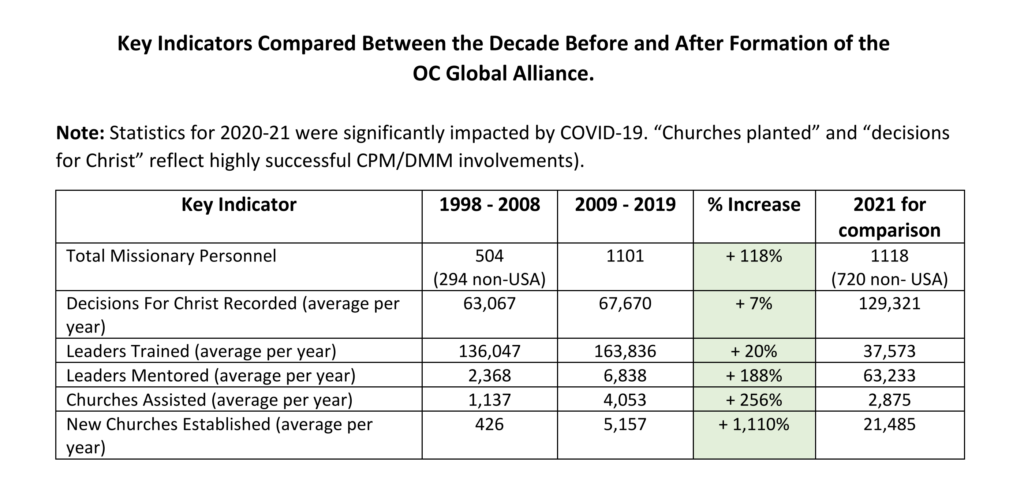
As with any structure, our Alliance model has some challenges. Our commitment to individual MC autonomy has allowed for growing diversity in how we seek to accomplish our vision in each unique context. While this liberates creativity and innovation, it also complicates measuring shared objectives and the reporting process (we continue to produce a comprehensive annual ministry report for the Global Alliance).
Our alliance is built on the foundation of solid relationships and unifying essentials. Still, over time, we are starting to see leadership transitions in our MCs, which present a risk to that strong foundation. Recognizing this threat, we have increased the frequency of our virtual gatherings to fortify our relationships and commitment to our unifying essentials. In addition, we struggle with some cultural and linguistic barriers, but we are committed to the inclusion and participation of all our partners.
While no model may be perfect, we find that the alliance model has worked very well for OC. We continue to grow as individual MCs, and our international collaboration has increased exponentially. We continue to welcome new MCs into our alliance, and our leaders remain committed to the shared vision, mission, strategy, and values that brought us together.
More Information
Report submitted by:
Craig Kraft – Outreach Canada
Felipe Brown – SEPAL Colombia
Tony Lee – OC Singapore
Dean Carlson – One Challenge USA