Lessons from John Becker’s Team & the Nuba Mountains
POLYCENTRIC LEADERSHIP & THE FUTURE OF GLOBAL MISSION: PART 1
By JOSEPH W. HANDLEY, Jr.
The future of global mission leadership will not be determined by the strength of individual organizations. Increasingly, it will depend upon our ability to cultivate collaborative ecosystems capable of addressing complex challenges no single organization can solve alone.
Few examples illustrate this reality more clearly than the collaborative efforts emerging in Sudan and the Nuba Mountains under the leadership of John Becker and a growing network of indigenous and international partners.
Listening to Becker describe these initiatives during a recent PeopleVision webinar reminded me why polycentric leadership matters. The story is not primarily about organizational growth, strategic planning, or even mission effectiveness. At its heart, this is a story about how leadership can be shared across multiple centers of influence while maintaining unity around a common mission.
From Hierarchies to Networks
When asked to describe polycentric mission, Becker immediately emphasized what he called “many nodes and networks.” Rather than relying on top-down structures, he described leadership emerging through connection points where diverse actors contribute their expertise, experience, and perspectives.
His description closely mirrors what many global mission leaders are discovering today. The challenges facing the church are increasingly complex, interconnected, and adaptive. Traditional hierarchical models often struggle to respond quickly enough to changing realities. Polycentric leadership offers an alternative by creating multiple centers of initiative that remain connected through relationships, trust, and shared purpose.
Becker noted that technology and globalization have accelerated this trend. Voices that once remained on the margins now contribute directly to strategic conversations. Learning no longer flows exclusively from established centers of influence. Instead, innovation frequently emerges from unexpected places, including regions experiencing the greatest challenges.
This shift is particularly visible in Sudan.
Collaboration in a Context of Crisis
Sudan currently faces one of the most severe humanitarian crises in the world. Ongoing conflict has displaced millions and created enormous obstacles for gospel witness, leadership development, and church planting.
In such an environment, no single organization possesses the resources, relationships, or expertise required to address the challenges alone.
Rather than attempting to centralize control, Becker and his colleagues have intentionally cultivated a collaborative ecosystem involving local leaders, churches, mission agencies, prayer networks, development organizations, Scripture engagement specialists, and diaspora communities.
One example is the National Missionary Training Center in the Nuba Mountains. The initiative emerged from a shared concern for dozens of unengaged people groups in the region. Rather than creating another externally controlled structure, partners worked together to train and equip local missionaries capable of serving among neighboring unreached communities.
What makes this effort noteworthy is not simply the training itself. The initiative combines multiple streams of expertise:
- Disciple-making and church multiplication
- Agricultural development
- Income-generating activities
- Leadership formation
- Community development
- Scripture engagement
- Prayer mobilization
Each partner contributes according to their strengths while remaining accountable to a broader shared vision.
This is polycentric leadership in practice.
The Power of Shared Ownership
One of the most striking aspects of Becker’s reflections is his emphasis on local ownership.
Historically, mission efforts have often struggled with dependency. Outside organizations bring resources, establish programs, and unintentionally become the center of gravity. Local believers may participate, but strategic ownership frequently remains elsewhere.
The Sudan collaboration demonstrates a different approach.
The most effective initiatives are increasingly driven by Sudanese and Nuba leaders themselves. International partners contribute resources, relationships, and expertise, but decision-making and implementation are becoming more locally rooted.
This reflects one of the central principles of polycentric leadership: authority and initiative are distributed rather than concentrated.
Healthy movements do not depend upon a single leader, organization, or funding source. They develop multiple centers of leadership capable of sustaining momentum over time.
Building Trust Before Strategy
Perhaps the most important lesson from Becker’s experience is that collaboration begins with relationships.
Many networks fail because leaders focus on strategy before trust.
Becker repeatedly returned to themes such as:
- Trusted relationships
- Aligned vision
- Kingdom mindset
- Shared resources
- Accountability
- Celebration
These may sound simple, but they form the foundation of sustainable collaboration.
Trust allows leaders to share information openly.
Trust creates space for honest disagreement.
Trust enables organizations to contribute resources without fear of losing influence.
Trust allows diverse actors to pursue a common mission without requiring uniformity.
In polycentric systems, trust functions as the glue that holds multiple centers together.
Without trust, distributed leadership fragments.
With trust, it flourishes.
What Can We Do Together That We Cannot Do Alone?
One question Becker highlighted has remained with me:
“What can we do together that cannot be done independently?”
This may be one of the most important leadership questions facing the global church today.
For much of modern mission history, organizations have focused on maximizing their own effectiveness. Polycentric leadership shifts the conversation.
Instead of asking, “What can my organization accomplish?” leaders begin asking, “What becomes possible when we work together?”
The Sudan story suggests that some of the greatest opportunities before us lie not in strengthening individual organizations but in strengthening the ecosystems that connect them.
Lessons for Global Mission Leaders
Several lessons emerge from this case.
1. Complex problems require collaborative solutions.
No single organization can adequately address the realities of war, displacement, poverty, leadership development, and unreached peoples simultaneously.
2. Leadership is increasingly networked.
Influence flows through relationships rather than positional authority alone.
3. Local ownership matters.
Sustainable movements emerge when indigenous leaders become primary actors rather than perpetual recipients.
4. Trust is strategic.
Relational capital is not secondary to mission effectiveness; it is foundational.
5. Polycentric leadership is not theoretical.
It is a practical framework already shaping some of the most innovative mission initiatives in the world today.
Looking Ahead
As Christianity continues its shift toward a truly global and polycentric future, stories like Sudan challenge many of our assumptions about leadership.
The future may belong less to large centralized institutions and more to collaborative networks united around shared vision and mutual trust.
John Becker’s experience in Sudan offers a compelling glimpse into that future.
In the midst of conflict, displacement, and uncertainty, we see multiple leaders, organizations, and communities learning to work together around a common mission. We see authority shared, resources leveraged collectively, and innovation emerging from the margins.
Most importantly, we see a living example of what polycentric leadership can look like when practiced in service of God’s mission.
The question before the rest of us is whether we are willing to learn from it.
More information
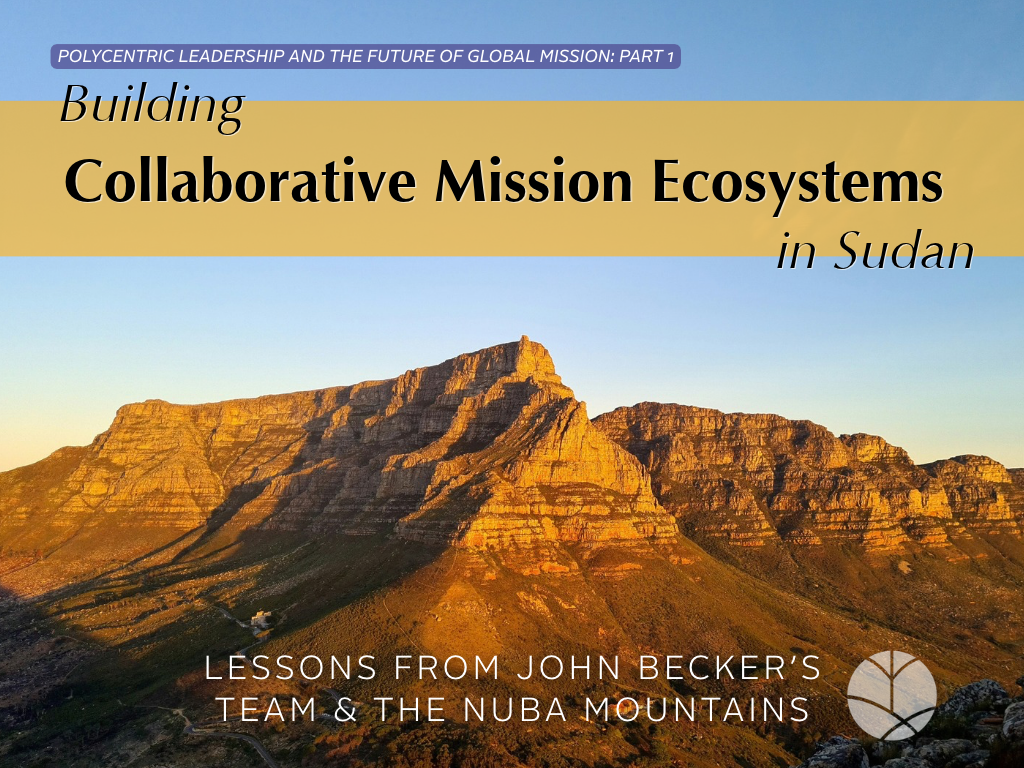
- Header photo of mountain by Rutendo Petros on Unsplash
- This article is part 1 of a series from the Lausanne Least Reached Peoples Issue Network webinar: on International Multiplication: Polycentric Pioneers and Collaboration!

The Lausanne Movement’s Least Reached Peoples Issue Network focuses on mobilizing the global Church to reach unreached people groups through prayer, humility, contextualization, and collaboration, leveraging modern technology and Bible translation efforts. It emphasizes empowering local leaders and addressing both spiritual and physical needs to advance God’s Kingdom worldwide.