
A friend who made room for others, and the book he conceived in a hospital bed
By JOSEPH W. HANDLEY, Jr., Ph.D.
I promised Dr. Sadiri Joy Tira that I would feature One Seed Many Soils on this site. Joy has since gone home to the Lord, and the promise means more to me now than when I made it. So this is a tribute to my friend as well as an introduction to the book he gave the last months of his life to.
A champion of others

Joy was an amazing advocate for others, and he gave a platform to countless people. Without him, I doubt my Polycentric Mission Leadership venture would have the legs it has today. He was pivotal in extending the reach of the polycentric endeavor, and the multiplying effect since then has been enormous.
He encouraged the work with the Oxford Centre for Mission Studies and Regnum, and then kept the ideas moving through his posts and even through this book. He was probably my biggest cheerleader when it came to polycentric leadership!
I am far from the only one who could say that. In his foreword to this book, Allen Yeh calls Joy “a connector” who “thinks big.” For decades Joy used his network to open doors for other people.
Many will remember him first for his pioneering work in diaspora missiology. He served as the Lausanne Movement’s Senior Associate for Diasporas, and he was the founding chair of the Global Diaspora Network. He helped the church see migrants and scattered peoples as part of God’s mission: people to be reached and discipled, who then carry the gospel wherever they settle. Yeh notes that Joy’s earlier book was Scattered and Gathered, and suggests this one is its mirror image: Gathered to Scatter.
I had the privilege of writing one of the forewords for this volume. Reading it again now, I notice how closely the way Joy put the book together matches what it says. He gathered people from different cultures, generations, and ministries to think together about how Christ builds his church. That way of working is itself polycentric leadership.
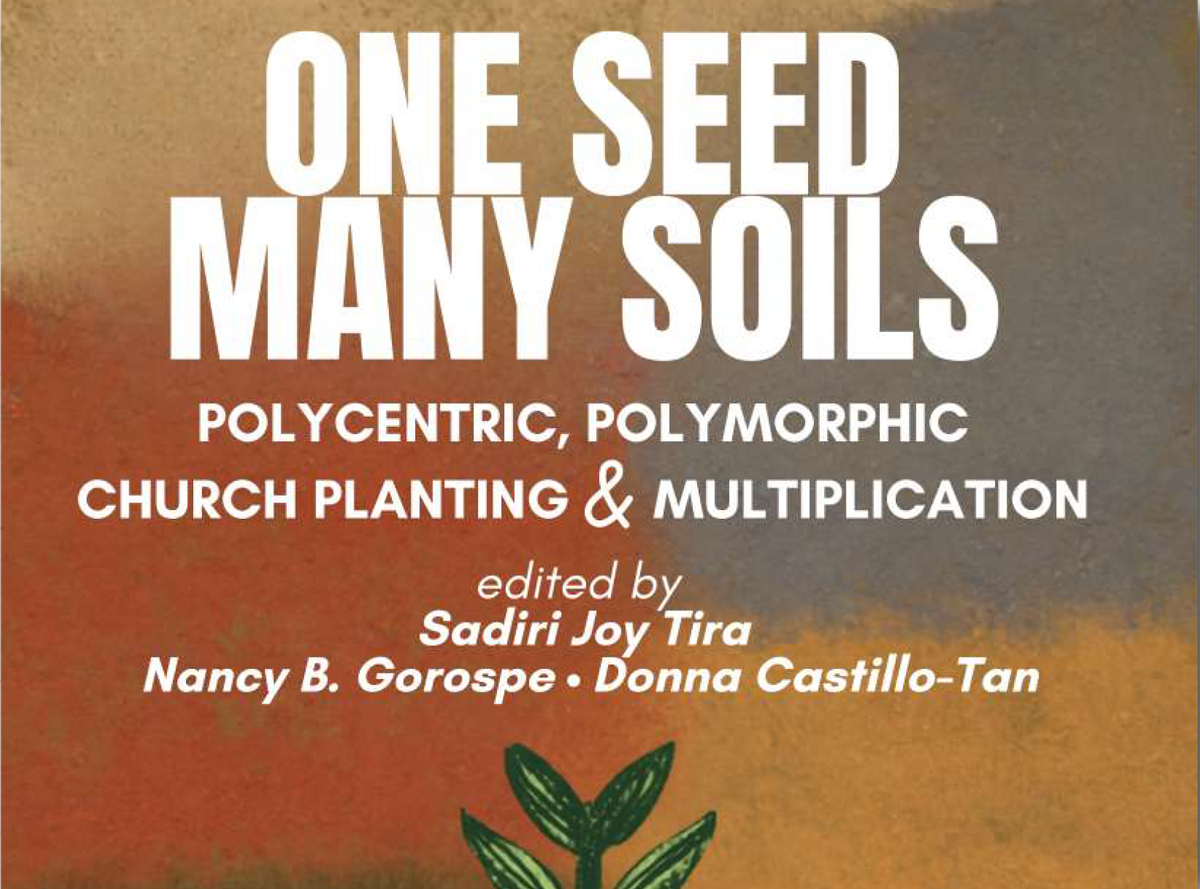
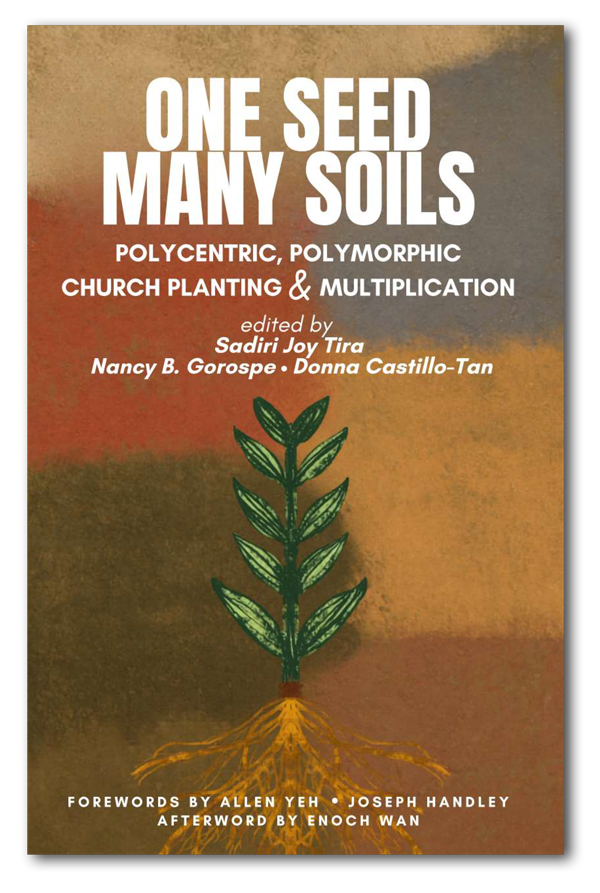
The book’s full title is One Seed Many Soils: Polycentric, Polymorphic Church Planting & Multiplication. Edited by Joy with Nancy B. Gorospe and Donna Castillo-Tan, it sets biblical reflection alongside the stories of practitioners working in very different places.
One seed, many soils
The book began with a parable. In Matthew 13:1–23, a sower scatters seed across a hardened path, rocky ground, thorny ground, and good soil. The seed is the same everywhere it falls; what differs is how it is received.
Notice that even the good soil does not yield a uniform harvest: some produces a hundredfold, some sixty, some thirty. Even where the seed is received well, the results differ.
The book takes Jesus’ image beyond the individual heart to the many places where the gospel takes root. The gospel is not ours to reshape. But the soils differ, and so does the harvest. As I wrote in my foreword, the diversity of cultures and contexts is not a problem to be managed. It is a gift to be received.
Conceived in a hospital bed
In his preface, Joy describes months spent between Edmonton hospitals from late 2025 into 2026. He called those hospitals his “place of refuge, repairs, restoration, and renewal.” On November 30, 2025, while at Glenrose Rehabilitation Hospital, he was reading Matthew 13:1–23 when the idea for this book came “like flashes of light.” He grabbed his phone and typed the title. After his discharge, he shared the vision with his inner circle. During another hospitalization, he began listing contributors from his global network.
In his own chapter, Joy writes that in February 2005, after Bible studies at home and in the hospital with a terminally ill man and his relatives, nearly everyone at a worship service in that same Glenrose Hospital accepted Christ. Twenty years later, Joy received the vision for this book in the same building. God had been sowing in that soil for a long time.
Donna Castillo-Tan later told the contributors that when Joy went home to be with the Lord, the manuscript had already reached the publisher. He was still directing the project and writing to potential reviewers near the end.
Joy was not the only contributor writing through weakness. In their closing words, Joy and Enoch Wan both note that several of the writers were dealing with stroke, disability, or old age while they wrote. We tend to link leadership with strength and visibility. This book was written by several people whose bodies were limiting them, and it was carried by prayer, dependence on God, and friendships that held.
Many centers, many expressions
The two words in the subtitle belong together. Polycentric mission recognizes that initiative and leadership arise from many centers. Polymorphic mission recognizes that churches develop different expressions as they respond faithfully to their settings. Allen Yeh puts the distinction well: polycentrism describes the outward, geographic spread of mission, while polymorphism describes the church’s ongoing adaptation over time. He argues that neither can exist without the other.
None of this means every approach is equally sound. Scripture, discipleship, and the life of the church still matter. But it should make us slower to assume that the way we do ministry is the template for everyone else.
The chapters show what this looks like. Its nineteen chapters range from churches among seafarers on the world’s oceans to house church networks in the Buddhist world, from witness amid Myanmar’s political crisis to immigrant congregations in Melbourne and New York, and from a megachurch in Manila to isolated farming communities in northern Alberta. The last chapter, fittingly, remembers another church planter who has died, Dr. Thomas Wang, and is written to encourage the next generation.
In his chapter on redemptive ecclesiology, Sadiri Tonyvic Tira Jr. describes Supper Club, a Christian community in Edmonton organized around meals, Scripture, prayer, and neighborhood engagement. The meal table becomes the place where people grow in faith and take on responsibility. For leaders, the point is that our structures should help people take part in God’s mission where they already live.
Joy’s own chapter gives a second example.
Nurturing new centers: the kangaroo model
Joy first published his kangaroo model nearly two decades ago, and it still offers useful questions for church leaders. (Allen Yeh admits it is the first time he has heard the church compared to a marsupial!) His case study is First Filipino Alliance Church in Edmonton, a congregation he knew well, which began as an ethnic sub-congregation within Millbourne Alliance Church. After four years, it “jumped out” of the pouch as a congregation able to govern, sustain, and reproduce itself.
He draws a few pictures from the kangaroo. A healthy mother kangaroo is almost always pregnant, and Joy urges churches to keep preparing for multiplication while discerning when a new congregation is ready. Launching a church before it is ready, he warns, amounts to “church-planting infanticide.” And a mother kangaroo produces different milk for joeys at different stages, so mother churches must tailor their training and resources to each new congregation’s stage of growth.
Joy then proposes that First Filipino Alliance Church do for a daughter congregation what Millbourne once did for it. The chapter doesn’t say how that proposal turned out, but it gives leaders a way to think through similar decisions today.
Three lessons stand out to me.
First, nurture should fit the stage of development. Anemerging congregation needs appropriate training, pastoral care, and resources. A maturing church needs room to exercise responsibility. Leaders have to work out what each community needs at each stage.
Second, releasing people requires preparation. Joy’sproposal includes intentional prayer, identifying and mentoring a core team, studying the community, and working with denominational partners. Multiplying churches takes patience and close attention to the people and the place.
Third, maturity can deepen partnership. Joy laments that daughter churches are too often treated like “renters” who receive little support and then sever ties when they move out. He argues instead that relationships between congregations should continue after a daughter church becomes self-sustaining. He even envisions daughters strengthening their mothers when circumstances change. Support runs both ways.
Strong centers that make room
In my own research, I stress that healthy polycentric systems still need strong centers, connected to others through relationships of mutual support. People sometimes hear “polycentric” and assume it means decentralized, with no center at all. Joy’s kangaroo model shows why that is a misreading.
Millbourne functioned as a core. For four years it gave a young congregation a home in which to mature, then released it to govern, support, and propagate itself. Joy’s model asks for more than release: mother and daughter should remain family, supporting each other long after the launch. The joey leaves the pouch, but it stays part of the family.
Planting churches is not polycentric by itself. A mother church can plant daughters and still keep control of them. It becomes polycentric when new communities become responsible centers of mission in their own right, free to lead and take initiative, while staying connected in mutual support. That, to me, is what polycentric leadership looks like: established centers using their resources to nurture new ones, entrusting them with responsibility, andcontinuing to learn and serve alongside them. It calls for several of the traits we see in polycentric leaders, especially being collaborative, relational, and communal. It is also how Joy led. He was a strong center, and he used that strength to make room for other people.
Carrying the work forward
The book was made the same way. Joy brought together a varied group of writers and let each one speak from their own setting. Nancy, Donna, and the wider team shaped the manuscript, and now they are finishing what he started.
I commend the book to church planters, pastors, denominational leaders, mission leaders, and anyone who wants to see how the global church can learn and lead together. The appendix has discussion questions for each chapter, so it works well for leadership teams and small groups.
Here are a few questions from Joy’s work that I want to take to my own teams:
- Whose experience do we need to hear?
- Which emerging leaders are we preparing to entrust with responsibility?
- How can our relationships help new communities flourish?
I ended my foreword with a few lines that mean more to me now. The future of mission does not depend ultimately on our strategies, structures, or systems. The power is not in the sower. The power is in the Seed.
Joy sowed faithfully his whole life. The best way I know to honor him is to keep sowing, keep nurturing new leaders, and trust God for the growth.
More Information
One Seed Many Soils: Polycentric, Polymorphic Church Planting & Multiplication.Sadiri Joy Tira, editor, with Nancy B. Gorospe and Donna Castillo-Tan. Western Academic Publishers, 2026. ISBN: 978-1-954692-38-1.